The ChatGPT Pentagon deal became official in late February 2026, when OpenAI signed an agreement with the U.S. Department of Defense to run its AI systems inside Pentagon networks, including some classified environments. These are the same kinds of models that power ChatGPT, but they run on separate, government-controlled infrastructure instead of the public systems creators and media pros use every day.
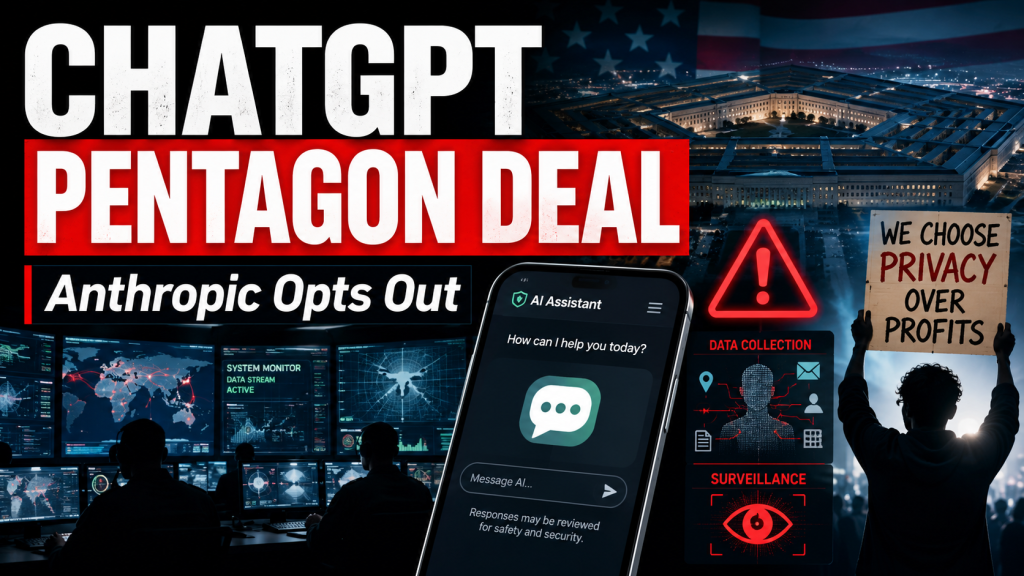
That move put one of the most popular consumer AI tools directly inside U.S. military systems and quickly raised questions about privacy, data use, and whether users should rethink how much of their creative and business workflow they run through ChatGPT.
What the ChatGPT Pentagon Deal Actually Provides
The Pentagon is not logging into the public ChatGPT website or mobile app for classified work. Under the agreement, OpenAI’s models run inside secure government clouds and Defense Department platforms built for internal use, including some classified networks.
The main use cases are practical and behind the scenes:
- Analyzing large volumes of data for planners and analysts
- Helping with logistics and operational planning
- Supporting cybersecurity and technical investigations
- Drafting and summarizing reports, memos, and documentation
OpenAI says this is a cloud-only deployment with its safety systems still in place, and that it is not putting models directly on weapons or edge devices that could independently control lethal force.
Separation From Consumer ChatGPT
For everyday users and content creators, the key message from OpenAI is separation. The Pentagon deployment and the consumer ChatGPT product are described as different systems with different environments, different data, and different users.
According to OpenAI, the military instance:
- Runs on separate networks and hosting infrastructure
- Uses government data, not public user chat histories
- Is restricted to authorized, cleared personnel
The company also says the Pentagon system is not supposed to be used for domestic surveillance of U.S. persons, including the use of commercially acquired personal data for that purpose. Intelligence-focused agencies such as the NSA are described as outside the scope of this specific agreement and would need separate terms if they wanted access.
On paper, that means there is no direct, contractual path for the Pentagon to read individual civilian ChatGPT conversations from the public service. Privacy advocates point out that these promises exist alongside broad U.S. surveillance and intelligence laws, which already allow wide data access under certain authorities.
Why Some Users Pushed Back
Once the deal became public, some users reacted strongly, including people who had built parts of their workflow around ChatGPT. For creators, journalists, and small media businesses, ChatGPT had been a neutral helper for scripts, emails, research, and copy, not a tool associated with classified military work.
The main concerns look like this:
- Users have poured sensitive prompts, drafts, and ideas into a system whose operator is now a formal defense contractor.
- Early “all lawful purposes” language in the contract was seen as very broad given how wide U.S. surveillance law can be.
- There is uncertainty about how “no domestic surveillance” promises can be monitored or enforced inside closed, classified environments.
Some people responded by deleting accounts, moving sensitive work to other tools, or splitting their stack so that not everything runs through a single AI vendor. Others stayed but are watching how future military and government deals evolve before deciding how much to rely on OpenAI long term.
How Anthropic and Claude Responded
OpenAI’s contract did not happen in a vacuum. It followed a months-long dispute between the Pentagon and Anthropic, the company behind Claude, which had its own prototype contract to provide AI inside some Defense Department systems.
According to congressional and policy summaries, the fight came down to two red lines Anthropic would not cross:
- Allowing Claude to be used for mass domestic surveillance of people in the United States
- Allowing Claude to operate fully autonomous weapons systems
The Pentagon pushed for language that would allow “all lawful use cases,” including potential applications in autonomous weapons and broad surveillance, as long as they complied with U.S. law. Anthropic argued that current frontier AI systems are not reliable enough to safely power fully autonomous weapons and that mass domestic surveillance conflicts with its safety commitments.
Anthropic refused to remove those restrictions, even after senior officials warned the company it could lose a large contract if it did not change course. The Trump administration then ordered federal agencies to stop using Anthropic’s technology and designated the company a “national security supply chain risk,” effectively cutting it off from U.S. government work for now.
In short, Anthropic opted out of the Pentagon’s requested terms for Claude, knowing that meant walking away from up to 200 million dollars in potential work and future federal contracts.
How OpenAI Adjusted Its Language
When OpenAI first described its own Pentagon agreement, it used similar “all lawful purposes” wording, which immediately invited comparisons to the Anthropic fight. After pushback from civil society groups, researchers, and users, the company updated its public explanation and highlighted additional guardrails.
OpenAI now stresses three main limits:
- No use of its systems for mass domestic surveillance of U.S. persons
- No use to directly control autonomous weapons systems
- No use in high-stakes automated systems such as social credit scoring
The company also points to technical safety layers and cleared OpenAI staff working alongside government teams as part of its approach. Supporters say this shows OpenAI pushed for protections similar to the concerns Anthropic raised. Critics note that core parts of the contract remain classified and that “all lawful purposes” still covers a lot under current U.S. law.
What It Means For Creators And Media Pros
For RadioFacts readers who use AI to write copy, shape shows, script videos, or run small media businesses, this comes down to a few practical questions:
- Are you comfortable depending heavily on an AI provider that is now deeply embedded in classified military programs?
- Do you want one main AI tool, or do you spread work across multiple vendors with different policies and risk profiles?
- If your audience, clients, or partners ask about privacy and ethics, can you explain why you chose this tool and how you use it?
Right now, there is no public evidence that the Pentagon can read private chats from the consumer version of ChatGPT, or that the ChatGPT Pentagon deal directly exposes user prompts to military surveillance. The issue is less about today’s interface and more about where these relationships go over the next few years.
The Larger Shift
Taken together, the OpenAI contract and the Anthropic dispute mark a clear shift in where AI sits in the culture and the economy. Generative AI has moved from “cool tool for emails and ideas” into the middle of national security planning, and companies are being forced to decide where they draw their own lines.
Anthropic chose to hold firm on bans against mass domestic surveillance and fully autonomous weapons, even at significant financial and political cost. OpenAI chose to move forward with a new classified agreement that it says has stronger guardrails than any previous AI contract with the Pentagon.
For creators and media professionals, the immediate experience of using ChatGPT or Claude may feel the same. The real change is in the background: the same class of tools that help write breaks, newsletters, scripts, and sales decks are now also embedded, under different rules, in some of the most powerful institutions in the world.