Music Offices Unite to Build Local Industry Power
Publishers and songwriters could see new business opportunities from a national effort designed to make local music economies more organized, measurable and better funded.
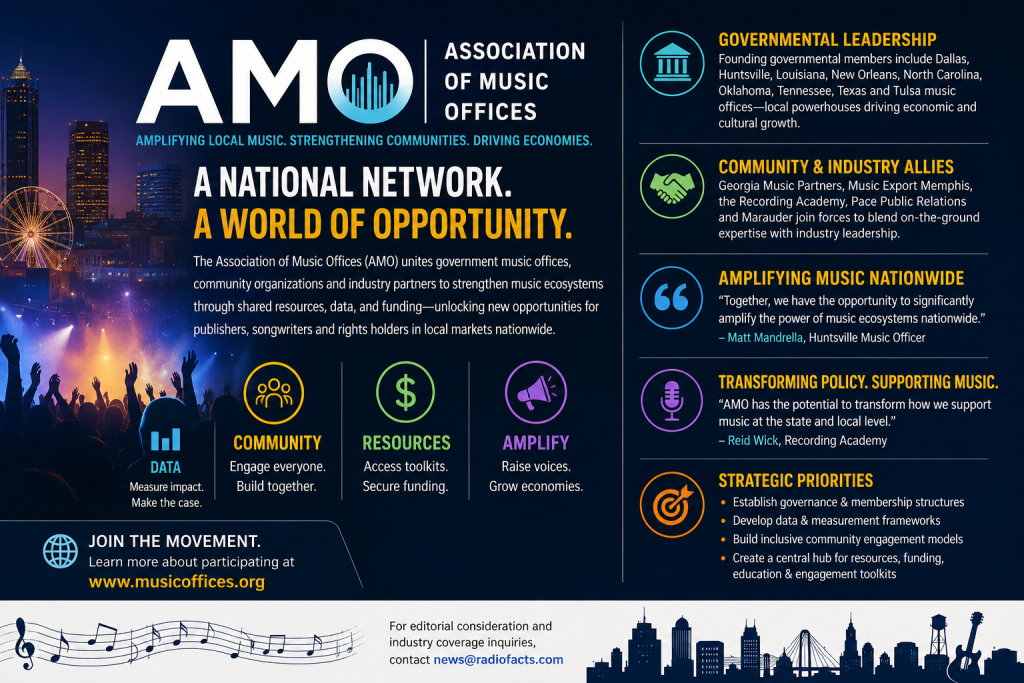
The Association of Music Offices, known as AMO, has launched as a new trade group bringing together government music offices, community organizations and industry partners focused on strengthening music ecosystems across the country. The organization was announced Monday, May 11, during the Music Biz 2026 conference in Atlanta.

The timing matters. More cities and states are treating music as an economic development issue instead of a side conversation. That shift could create new openings for publishers, songwriters, rights holders and music companies looking for more than national chart visibility. Local scenes need infrastructure, data, funding models, policy support and professional pipelines. AMO is being built around those needs.
Local Music Is Becoming Economic Policy
AMO launches with 14 founding members, including government offices, nonprofit music organizations and industry affiliates. The governmental founding members include the Dallas Music Office, Huntsville Music Office, Louisiana Office of Cultural Development, New Orleans Mayor’s Office of Nighttime Economy, North Carolina Music Office, Oklahoma Film + Music Office, Tennessee Entertainment Commission, Texas Music Office and Tulsa Office of Film, Music, Arts & Culture.
That lineup gives the organization reach across several regions where music already plays a major role in tourism, live performance, cultural development and creative business activity. For publishers and rights holders, the bigger issue is whether these offices can help create stronger local systems that lead to more licensing opportunities, songwriter support, live music investment and community-based revenue.
Music has always had local roots. The difference now is that cities are starting to ask what those roots are worth.
Industry and Community Groups Add Support
AMO also includes community and industry founding members such as Georgia Music Partners, Music Export Memphis, the Recording Academy, Pace Public Relations and Marauder. That mix gives the group a broader base than a government-only coalition.
The organization is expected to focus on shared resources, data models, community engagement and funding tools. Those are not small administrative details. For years, local music ecosystems have often had the talent, the history and the audience, but not always the structure needed to turn that activity into measurable economic leverage.
That is where AMO could be useful. If local music offices can better document music’s impact, they can make stronger cases for grants, civic investment, workforce development, venue support and creator-focused programs. Those outcomes matter to songwriters and publishers because organized ecosystems usually create more professional opportunities than scattered scenes operating on goodwill and memory.
Huntsville’s Music Officer Points to a Bigger Opportunity
Matt Mandrella, the music officer for Huntsville, Alabama, said AMO is designed to help cities recognize music as both an economic and quality-of-life driver.
That point is important because many cities promote music culturally but fail to build policy around it. They celebrate artists after the fact, but they do not always invest in the systems that help creators stay, work and earn locally.
AMO appears to be pushing that conversation into more practical territory. The early priorities include governance, membership structure, data and measurement frameworks, inclusive community engagement models and a central resource hub with toolkits, funding mechanisms, education and other support programs.
For publishers, that data piece may become one of the most useful parts. Numbers help move conversations with civic leaders, sponsors, institutions and funders. Without measurement, music gets treated like atmosphere. With measurement, it becomes economic activity.
Why Publishers Should Pay Attention
The immediate benefit for publishers and songwriters is not automatic money. That would be overselling it.
The real opportunity is infrastructure. If AMO helps more cities build professional music offices with credible data, stronger partnerships and better funding access, rights holders may find new ways to connect with local music economies. That could include sync opportunities, songwriter programs, catalog activations, venue partnerships, education initiatives and regional campaigns tied to civic and cultural development.
It also gives overlooked markets a better shot at visibility. Not every valuable music scene sits in New York, Los Angeles, Nashville or Atlanta. Cities with serious talent often lose momentum because there is no organized system connecting artists, venues, publishers, educators, funders and public officials.
AMO is trying to create a national framework for that work.
First Year Will Show the Real Value
The first year will determine whether AMO becomes a practical industry tool or another well-meaning organization with a polished mission statement. The difference will come down to execution.
If the group can help music offices produce useful data, secure funding, share working models and bring more regions into the conversation, it could become a meaningful resource for the business side of local music. If it stays too broad, the industry will move on.
For now, publishers, songwriters and rights holders should watch closely. Local music economies are no longer just cultural talking points. Cities are starting to understand that music has measurable value. The people who own, manage and create the work need to be part of that discussion early.
For editorial consideration and industry coverage inquiries, contact [email protected].