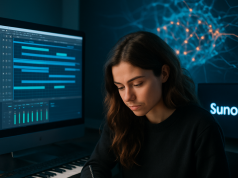
The music industry’s first mature opt-in attribution model for AI training has reached a critical milestone, with over 30,000 artists now participating in LANDR’s Fair Trade AI program. This development offers a tangible alternative to the prevailing narrative of artist displacement, providing labels, publishers, and rights holders a verified framework for consent-based licensing that generates recurring revenue. For radio programmers and Black music professionals, this model demonstrates how technology can evolve without erasing creator value, setting a potential standard for future industry negotiations regarding artificial intelligence.
Consent-Based Licensing Drives First Payouts
Two years after launching the initiative, LANDR reports that hundreds of thousands of tracks are now available for training AI tools, with the first revenue payouts scheduled to occur later this month. The program explicitly asks artists to opt in to having their music used for AI training, granting them a share of revenues generated by the company’s AI plugins, apps, and services in return. Unlike previous models that relied on blanket licenses or ambiguous data usage, this system ensures that only distributed tracks where the artist retains full publishing and recording rights are eligible. Cover songs and tracks represented by third-party publishers are strictly excluded to maintain rights clarity.
Revenue Share Increases and Advance Fund Launch
LANDR is significantly expanding the financial incentives for participants by raising the net AI-licensing revenue share allocated to the payouts pool from 20% to 25%. The company is also introducing a £1 million fund to pay recoupable advances of $5 per eligible track, with the program open for opt-ins until July 20, 2026. These advances must be recouped from future monthly payouts before artists receive their share of the 25% revenue. The revenue calculation is proportional to data contribution; for instance, if an artist contributes one track out of 10,000, they receive one ten-thousandth of the 25% net revenue, minus direct charges.
Strategic Partnerships Target Next-Gen Audio Tech
While LANDR has not disclosed specific licensing partners, the company states it is targeting AI firms developing next-generation audio technologies, including creative tools and voice technologies. The dataset itself will not be sold to third parties, ensuring that data remains within LANDR and its co-development partners to safeguard user music. This approach aligns with a November study of 1,200 musicians, which found that 87% are already using AI in their creative process. By proving that consent and recurring revenue can coexist with technological evolution, LANDR is establishing a new path for artists to benefit from the value created by AI development.
For editorial consideration and industry coverage inquiries, contact Radio Facts.